3233 - Madison, Wisconsin, United States of America

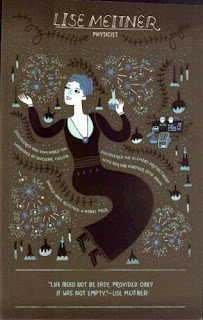
Lise Meitner was a physicist born in Austria-Hungary, but gained Swedish citizenship in 1949. She is responsible for the discovery of protactinium and nuclear fission. Protactinium is a radioactive chemical element (Pa). It reacts with oxygen, water vapor, and inorganic acids. 

She discovered protactinium in 1917 while at the Kaiser Wilhelm Institute of Chemistry in Berlin. Meitner and her nephew, Otto Robert Frisch, discovered nuclear fission in 1938.

She was nominated for the Nobel Prize in Chemistry 19 times between 1924 and 1948, and the Nobel Prize for Physics 30 times between 1937 and 1967. In 1944, her collaborator Otto Hahn won the Nobel Prize in Chemistry for nuclear fission. Many scientists called her exclusion unjust. 

Chemical element 109 meitnerium was named for her in 1997. 


Comments

Popular posts from this blog

3566 - Bakhmach, Chernihiv, Ukraine

Bakhmach is locarted in northern Ukraine. I'm taking this next paragraph straight out of Wikipedia: During the  Russian invasion of Ukraine  on February 26, 2022, at least 65 units of Russian military equipment moved through Bakhmach, with about a hundred more on the outskirts. Local residents tried to stop the convoy on their own by blocking tank tracks with makeshift objects and convincing Russian soldiers not to move towards  Kyiv . One man attempted to climb onto a tank and block the road with his body (he was not hurt). However, the military equipment continued to move, and Russian forces fired several shots into the air. Слава Україні!

3564 - Kassel, Hesse, Germany

A wonderful message on this card that translates to to those wh o can wait, everything comes with time.

2352 - Cologne (Köln), North Rhine-Westphalia, Germany

Cologne is home to the twelve Romanesque churches. All are Catholic churches and all are found in Altstadt (old town). All were severely damaged during the 262 Allied air raids on Cologne. All twelves have been restored. St. Andreas was consecrated in 974. The crypt of the church as a sarcophagus that dates back to the third century and it holds the remains of St. Albertus Magnus, who died in 1280. St. Apostein was consecrated in the 800s. St. Cecilia was built in the 800s and it the current home of the Schnutgen Museum for Medieval Art. It still holds Catholic Mass on rare occasions.  St. Georg's was built near the end of 1000s. It was extensively restored after the Second World War. St. Gerion's was established in 612. St. Kunibert was consecrated in 1247. Cunibert, the 9th Bishop of Cologne, is buried here. St. Maria im Kapital was built between 1040-1065. It was also heavily damaged during the war and restoration was finally completed in 1984.  St. Maria Lyskirchem is the ...